
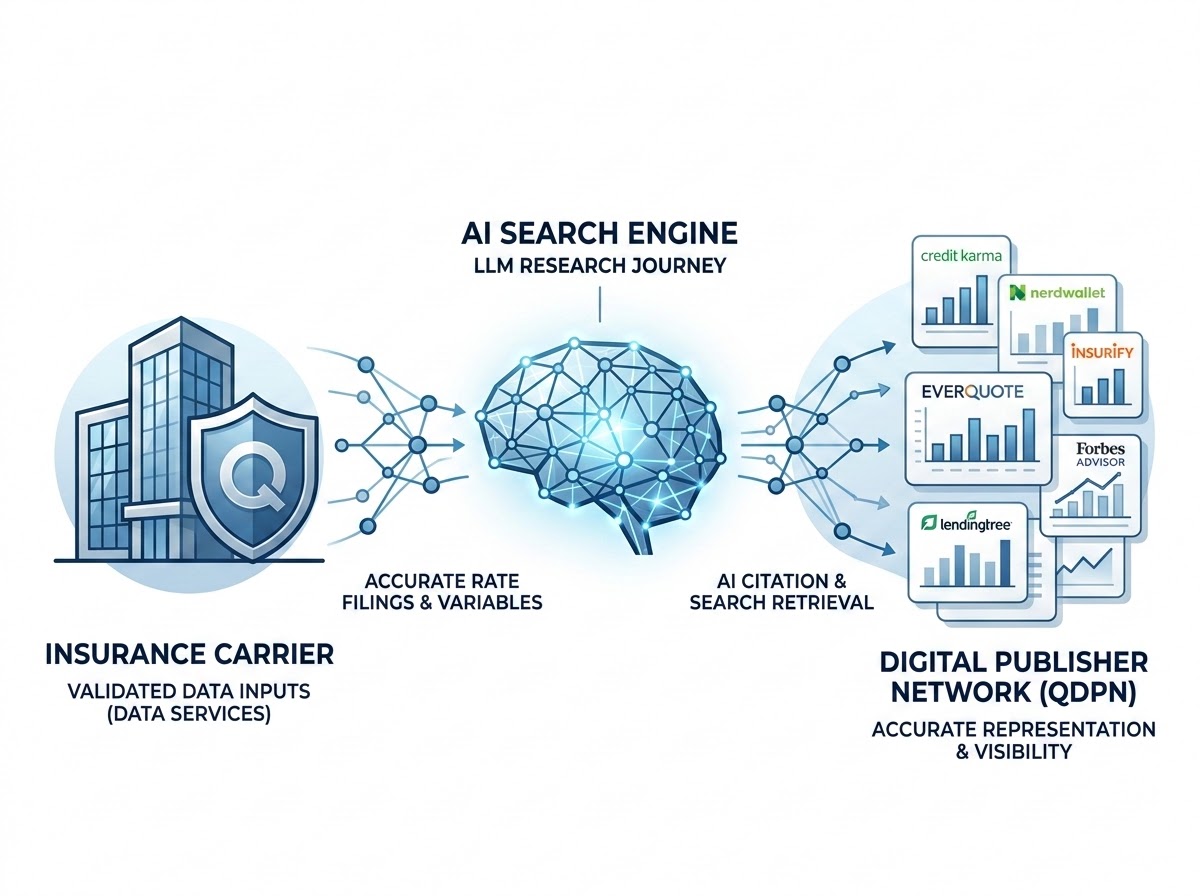
AI is changing how consumers find and evaluate insurance information. As large language models (LLMs) become part of the research journey, insurance carriers face a new challenge: ensuring they are accurately represented in the sources that AI systems retrieve, evaluate, and cite.
Quadrant’s Digital Publisher Network (QDPN) offers a useful case study. As the premier property and casualty (P&C) insurance rating data and pricing analytics provider, Quadrant serves as the underlying data backbone across the insurance ecosystem. QDPN brings together major digital publishers consumers rely on for coverage information, while Quadrant works directly with carriers through solutions like Data Services to ensure rate filings, proprietary rating variables, and underwriting guidelines are programmed, validated, and accurately represented. Together, they demonstrate how carrier-validated pricing intelligence maintains data precision and brand visibility as AI-driven search transforms consumer discovery.
The Subject: The Quadrant Digital Publisher Network
The QDPN includes Credit Karma, NerdWallet, LendingTree, EverQuote, Forbes Advisor, Insurify, The Zebra, ValuePenguin, U.S. News, MoneyGeek, and QuinStreet.
| Publisher | Monthly Visits | Note |
| Credit Karma | ~39.9M | Similarweb estimate, July 2026 |
| NerdWallet | ~25.3M | Similarweb estimate, July 2026 |
| LendingTree | ~7.9M | Plus 26M registered members |
| EverQuote | ~10M | Top-tier insurance marketplace |
| Forbes Advisor | ~4M | Similarweb estimate, July 2026 |
| Insurify | ~2–3M | Comparable to The Zebra |
| The Zebra | ~2–3M | #1 competitor to Insurify |
| ValuePenguin | ~800K–1M | LendingTree subsidiary |
| US News (Money) | ~1–2M | Estimated from site-wide traffic |
| MoneyGeek | ~300K | Confirmed |
| QuinStreet | ~1–2M | Primarily lead-gen |
Gross monthly touchpoints across the network run roughly 95–115 million, but that figure overstates real reach. Audiences overlap heavily, since a consumer shopping for car insurance will often visit NerdWallet, The Zebra, and Insurify in the same session. Applying an estimated 40–45% deduplication rate—derived from cross-site audience overlap models and consumer session tracking across QDPN member publishers—Quadrant puts unduplicated reach at 50–70 million distinct Americans per month who encounter insurance content across the network. That’s the number that matters for carrier planning, not the gross count.
Background Context: The Search Journey Is Changing
Traditional search still accounts for most purchase-intent traffic, but the trend is changing. About 37% of consumers now start their search with an AI tool rather than Google, and Gartner projects that traditional search volume will fall by 25% by the end of 2026. J.D. Power found that 41% of consumers used an AI tool during their insurance shopping journey.
This changes the visibility challenge for carriers. It’s no longer enough to show up in search results; a carrier’s information also needs to appear in sources that AI systems can retrieve and confidently cite. Digital publishers have responded by creating more structured, data-enriched content, because LLMs tend to favor sources with clear structure, verifiable data, and corroboration across the open web.
The Research Question
The central issue: How can an insurance carrier ensure consumers encounter accurate, validated information when researching coverage across digital and AI-driven channels?
Rate accuracy is the clearest version of this problem. Without a direct carrier relationship, Quadrant sources rate filings from SERFF and S&P Global. More often, though, carriers withhold key rating inputs, especially underwriting guidelines, which limit how accurately a filing can be reproduced. That creates a mismatch risk: a carrier may offer a competitive, accurately priced product, yet consumers encounter a less accurate reconstruction of it during the shopping process.
Data Collection Methods
This case study draws on Quadrant’s August 2026 LLM white paper, which combined:
• Traffic data
Similarweb estimates (July 2026, with some January 2026 figures) across QDPN member publishers, supplemented by modeled estimates where direct measurement wasn’t available
• Industry research
Gartner’s search-decline projections and J.D. Power’s 2026 Insurance Shopping Study
• Regulatory data
Rate filings from SERFF and S&P Global, used as a baseline absent a direct carrier relationship
• Network-level modeling
A 40–45% deduplication rate applied to gross visits, distinguishing gross traffic from estimated unique reach
Analysis and Findings
1. Visibility increasingly depends on the information ecosystem, not just the carrier’s own site
Consumers researching insurance are as likely to first encounter a comparison publisher as a carrier’s own website. With 50–70 million Americans engaging with this network monthly, third-party publishers now represent a major share of the discovery environment that carriers must account for.
2. AI systems reward structure, not just scale:
Publishers gaining ground aren’t necessarily the largest; they’re the ones producing content that’s well-structured, data-rich, and corroborated elsewhere on the open web, which is exactly what LLMs favor when selecting sources to retrieve and cite. As publishers improve on these dimensions, they gain outsized influence over the shopping experience relative to their raw traffic.
3. Carrier-validated data closes the accuracy gap:
A growing number of carriers participate directly in Quadrant’s network through Data Services, which manages the programming, maintenance, validation, and distribution of rating data. By working with Quadrant to program proprietary rating variables and underwriting guidelines that public filings from SERFF or S&P Global omit, carriers ensure their pricing is accurately represented across third-party comparison platforms. This validation is increasingly vital as shoppers evaluate more options; J.D. Power’s 2026 study found consumers now receive an average of 3.5 quotes, the highest in the study’s history.
4. Visibility and validation are two sides of the same problem
Some QDPN publishers use strategic ad placements and other tactics to increase carrier brand placement among aligned, in-market consumers. Paired with Quadrant’s validation work, this addresses both halves of the challenge: being seen and being represented accurately once seen.
Conclusion: Preparing for the Next Era of Insurance Search
The QDPN case study demonstrates that insurance visibility is becoming more complex as AI enters the consumer research process. Carriers still need strong direct digital presence, but that alone may not determine how consumers discover or understand their products. Third-party publishers increasingly shape the information environment, while LLMs create another layer through which that information can be retrieved and presented.
The practical lesson is that carriers should pay attention to both where their information appears and how accurately that information is represented.
Recommendations for Carriers
Strengthen data validation.
Work with trusted partners to validate rating information and incorporate carrier-specific inputs that may not be fully captured in public filings.
Monitor third-party representation.
Track how your products, pricing, and brand are represented across digital publishers by conducting periodic rate auditing across key comparison platforms, establishing digital shelf monitoring for brand messaging accuracy, and leveraging media monitoring tools to analyze LLM output citations.
Prioritize structured, verifiable information.
Accurate, clearly organized information gives publishers stronger source material and supports discoverability in AI-driven search environments.
Think beyond traditional search rankings.
As consumers increasingly use AI tools to research insurance, consider visibility across the broader information ecosystem, not solely within conventional search results.
AI-driven search is changing how consumers find insurance information. The carriers best positioned to navigate that shift will need to think beyond visibility alone and focus on the accuracy, validation, and context surrounding their brand wherever consumers encounter it.