
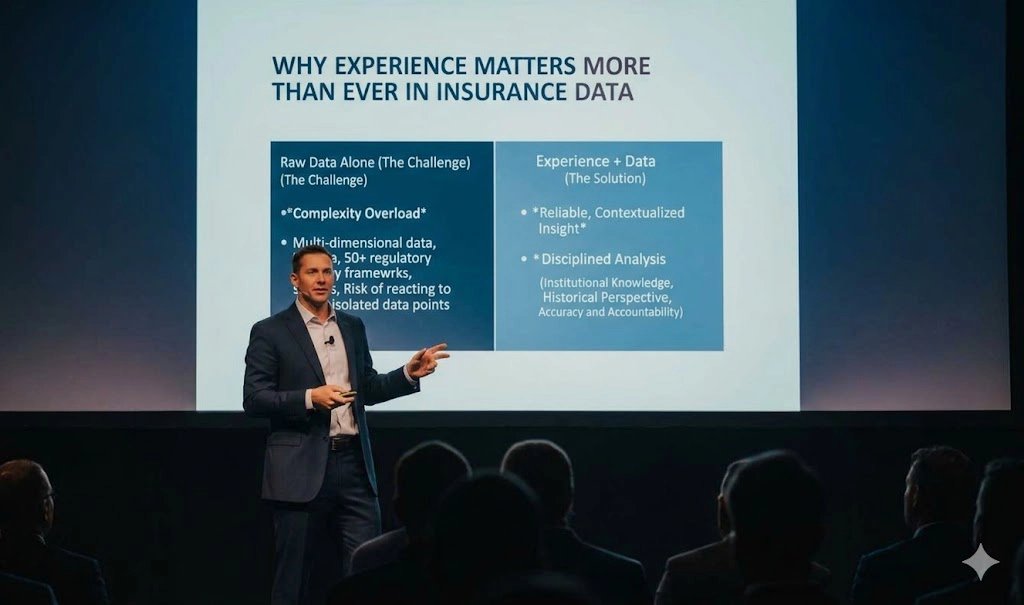
When Data Alone Is Not Enough
The insurance industry has never had more data at its disposal. The volume of available information, from detailed rate filings to specific geographic risk indicators, is growing rapidly. However, despite this abundance of data, confidence in decision-making remains inconsistent. Carriers, regulators, and analysts are navigating an environment shaped by increasing data availability and shifting market conditions. Recently, insurers moved through a period of aggressive rate increases following pandemic-era disruptions, only to begin moderating or reducing rates as profitability improved and competitive pressures returned.
These shifts are not uniform. Rate changes vary significantly by state, by carrier strategy, and by underlying rating factors, making it difficult to interpret market direction without deeper context. The key factor is not only access to data, but the ability to accurately interpret it. In an industry where even small misinterpretations can have serious consequences, experience is what turns raw data into reliable insights.
The Growing Complexity of Insurance Data
Insurance data is inherently complex. Each state operates under its own regulatory framework, which includes specific requirements for rate filings, approvals, and compliance standards. Even within a single state, pricing can vary significantly by location, risk exposure, and demographics. This variability poses a challenge for insurers.
Geographic granularity adds another layer of complexity to insurance pricing. Risk is not evenly distributed; location-specific factors, including weather patterns and population density, can significantly influence rates. As a result, insurance pricing data is inherently multidimensional.
Examining isolated data points without considering their context can lead to incomplete or misleading conclusions. Making informed real-world insurance decisions requires a structured approach that accounts for variability, regulatory nuances, the specific needs of the insured parties, and the potential impact of external factors.
Experience Turns Information Into Insight
Data shows what has changed, while experience explains why those changes occur. In property and casualty (P&C) insurance analytics, understanding these changes involves identifying rate movements or shifts in competitive positioning. It is also important to interpret these changes within the larger context of regulation, risk, and market behavior. Institutional knowledge is crucial in this process. Years of experience with rate filings, regulatory submissions, and pricing models provide a foundation for recognizing patterns that may not be immediately evident.
Certain shifts may seem significant when viewed in isolation, but they often reflect familiar cycles over time. Taking this broader perspective helps to minimize the risk of misinterpretation. Without this context, organizations might react to short-term fluctuations as if they indicate a structural change, potentially leading to decisions with far-reaching consequences. Experience adds discipline to the analytical process, ensuring that data is not only accurate but also properly understood. This distinction is crucial in a field where precision is vital.
The Value of Historical Perspective
Periods of disruption often highlight the importance of historical context. When markets change rapidly, there is a tendency to focus solely on current data. However, without a reference point, it can be challenging to determine whether observed changes are truly unprecedented or part of a longer trend. Historical insurance data serves as that vital reference point.
Following a period of widespread rate increases across many states, some carriers have begun implementing targeted rate reductions as profitability stabilizes and competitive dynamics evolve. In certain cases, these adjustments are substantial, reflecting strategic decisions around market share rather than purely actuarial indications.
Importantly, these changes are not consistent across the market. While some states are experiencing notable decreases, others continue to see increases driven by localized risk factors, regulatory conditions, or product-specific considerations. Even within a single state, variations in rating variables such as coverage types or risk segments can produce very different outcomes. Gaining insight into this type of rate movement necessitates observing filings and understanding how and why these changes occur across jurisdictions, carriers, and time frames.
A Bridge Between The Past And Present
Experience connects historical data to current decision-making, allowing insurers to interpret changes with greater confidence. Rather than simply reacting to isolated events, organizations can develop their strategies based on a thorough understanding of market behavior. In an industry focused on long-term risk assessment, maintaining this continuity is essential.
Over time, Quadrant Information Services has built and maintained one of the industry’s most comprehensive repositories of personal lines rate history, capturing how pricing has evolved across auto and home markets, jurisdictions, and regulatory environments. This historical depth reflects a long-standing commitment to continuity and precision, recognizing that meaningful insight depends on understanding change over time.
To support structured access to this historical intelligence, Quadrant developed RateVault™, a centralized environment for examining rate movement across years rather than isolated points in time. RateVault enables insurance professionals to analyze how variables, territories, and competitive positions have evolved, providing context that is often absent from short-term market analysis. This perspective does not replace real-time data or forward-looking models. Instead, it strengthens them.
Scale Built Over Time Matters
In insurance data intelligence, scale is not solely about volume; it also involves consistency, coverage, and continuous refinement over time. Having nationwide data that spans all 50 states and Washington, D.C., enables comprehensive comparisons across different regulatory environments and market conditions. However, simply having scale is not enough; the data must also be organized to ensure comparability.
Achieving this level of consistency necessitates years of disciplined data collection, normalization, and validation. It’s important to reconcile differences in filing formats, regulatory language, and rating methodologies to create a unified view of the market.
Building this type of infrastructure takes time and cannot be done quickly. It results from sustained investment and ongoing refinement, shaped by experience in navigating the complexities of insurance data. For insurers, this means more reliable insights. Comparisons become meaningful, trends are based on consistent data, and decisions can be made with greater confidence.
Accuracy And Accountability In A Public-Facing Industry
Insurance data does not exist in isolation; it influences internal decision-making and how the market is understood by regulators, policymakers, and the public. When insurance pricing trends are reported in the media, the underlying data becomes part of a broader narrative. In this context, accuracy is not optional, it is a responsibility. Misinterpretation or lack of context can lead to conclusions that affect public perception and policy discussions.
Speed often competes with accuracy in data reporting, but in the insurance industry, the balance must favor reliability. Data presented without proper context can oversimplify complex issues, obscuring the factors that drive pricing and risk. Experience acts as a safeguard against this oversimplification. It ensures that data is interpreted within the appropriate regulatory and market context, preserving its integrity even when translated for broader audiences. For organizations that rely on insurance data, accountability extends beyond internal use. It includes the responsibility to contribute to an informed and accurate understanding of the market.
Designed For Insurance Professionals
Behind every data point lies a decision. Actuaries, compliance teams, analysts, and product leaders depend on accurate insurance data to support pricing strategies, regulatory compliance, and competitive positioning. These professionals need more than just access to information; they require data that can withstand scrutiny. Questions regarding rate changes, competitive dynamics, and regulatory impacts must be answered with precision and supporting evidence.
Experience is evident in how data is delivered and used. Access to structured historical data, including tools like RateVault™, supports more defensible analysis across actuarial, compliance, and product teams. Structured data, consistent formatting, and clear context facilitate faster and more confident decision-making. In this setting, the value of data is determined not by its volume but by its usability.
Experience As Stability In A Changing Industry
Emerging risks, regulatory changes, and technological advancements are transforming how insurers operate and compete. While change is a constant factor, not every shift requires a complete reinvention. Experience provides a sense of stability, and it serves as a reliable framework for interpreting new developments without overreacting to short-term fluctuations. Instead of simply chasing trends, experienced organizations prioritize the integrity and reliability of their data. As the market evolves, precision, transparency, and consistency remain essential. These principles do not lose relevance over time; they become increasingly important as complexity grows. Experience does not resist change; rather, it helps contextualize it.
Why Experience Still Sets the Standard
Experience strengthens insight and ensures that data is understood within the broader context of regulation, risk, and market behavior. It reduces uncertainty, supports better decisions, and reinforces trust in the outcomes those decisions produce. Quadrant Information Services has long operated within this framework, supporting the insurance industry with data that is not only comprehensive but also contextualized and reliable.
Its role is not defined by visibility but by consistency, serving as a steady source of insurance intelligence in an evolving market. As the industry continues to navigate change, the importance of experience will only grow. Grounded in continuity and guided by precision, it remains the standard against which meaningful insurance insight is measured.